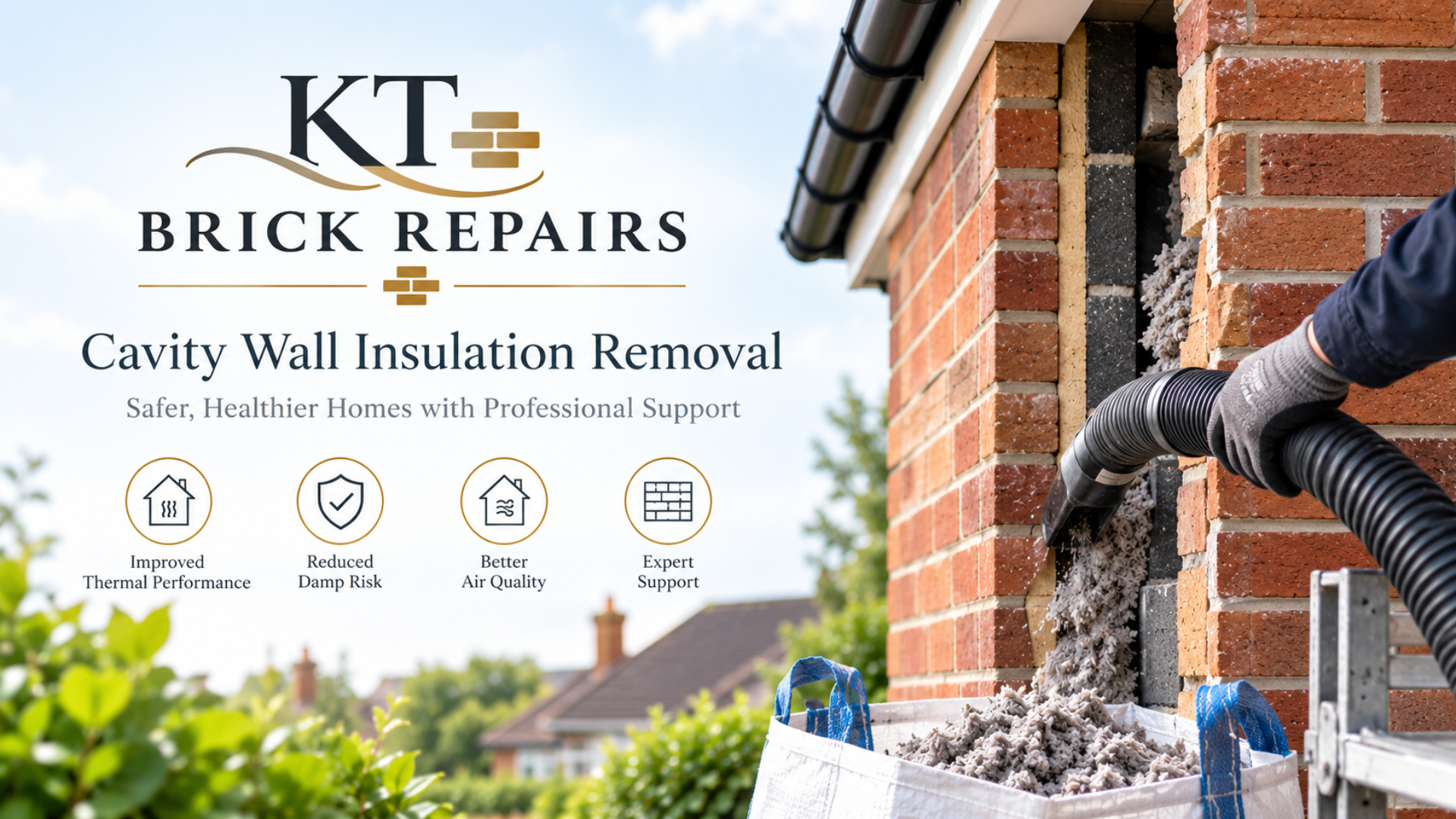
Cavity Wall Insulation Removal Islington
If you are concerned about defective, damp or unsuitable cavity wall insulation in your Islington property, it is important to establish the cause of the problem before arranging any remedial work. Cavity wall insulation can provide valuable thermal benefits when correctly specified and installed, but problems can occur where a property is unsuitable, the installation has failed, or moisture has entered the cavity.
KT Brick Repairs helps property owners in Islington explore suitable solutions by working with specialist cavity wall insulation companies. We do not carry out cavity wall insulation removal ourselves. Instead, where removal may be appropriate, we can help put customers in contact with specialist companies that assess the existing insulation and carry out the necessary extraction and associated work.
Government guidance recommends that defective cavity wall insulation should be properly assessed, with suitable evidence establishing why removal is necessary.
Cavity Wall Insulation Removal in Islington
Cavity wall insulation removal can be considered where existing insulation has become defective or is contributing to problems affecting a property. However, removal should not automatically be assumed to be the solution to every damp or condensation problem.
A specialist assessment can help determine whether the insulation itself is responsible for the issue and whether extraction is appropriate. Depending on the condition of the cavity and the building, other remedial work may also be necessary.
KT Brick Repairs provides a connection point for property owners looking for cavity wall insulation removal specialists in Islington. Through our network of specialist companies, customers can be directed towards professionals with experience in investigating and removing problematic cavity wall insulation.
Why Might Cavity Wall Insulation Need Removing?
There are several circumstances in which an existing cavity wall insulation system may require further investigation.
Potential issues can include:
- Damp patches appearing on internal walls
- Persistent moisture around external walls
- Water penetration associated with the cavity
- Insulation that has become wet or defective
- Poorly distributed or failed insulation
- A property that may not have been suitable for the original installation
- Deterioration associated with the age or condition of the installation
- Problems with the external wall or pointing that have affected the cavity
- Concerns about previous insulation installation work
It is important not to assume that cavity wall insulation is responsible for damp simply because it is present. Other causes, including defective pointing, damaged brickwork, leaking gutters, roof defects, plumbing problems and condensation, should also be investigated.
The UK Government has published guidance for householders who believe they may have experienced problems with cavity wall insulation and recommends following appropriate routes for investigation and redress.
How Is Cavity Wall Insulation Assessed?
Before extraction is considered, a specialist should normally investigate the condition of the wall and the insulation within the cavity.
This may involve examining:
- The external brickwork
- Mortar joints and pointing
- Existing damp or moisture damage
- The condition and distribution of the insulation
- The construction and condition of the cavity
- Exposure to driving rain
- Previous repair or insulation work
- Internal symptoms such as damp staining or mould
Current Ofgem guidance states that, where defective insulation is being considered for removal under relevant schemes, an appropriately qualified independent professional should inspect the property in person and establish the reasons for removal. The guidance also refers to more detailed inspection methods, such as borescope investigations, where appropriate.
Cavity Wall Insulation Removal Process
The precise procedure depends on the type of insulation, the construction of the building and the condition of the cavity.
A typical project may involve several stages.
Initial Property Assessment
The first step is establishing whether the insulation could be contributing to the reported problem. The property and surrounding building fabric should be considered rather than looking at the insulation in isolation.
Cavity Investigation
Specialist equipment may be used to inspect the cavity and determine the condition and distribution of the insulation.
This can help establish whether the insulation is wet, damaged, poorly distributed or otherwise unsuitable.
Removal Assessment
If the investigation indicates that extraction is appropriate, the specialist company can determine the most suitable removal method.
Insulation Extraction
Where removal is recommended, specialist equipment and procedures are used to extract the existing insulation from the cavity.
The approach will depend on whether the cavity contains mineral wool, polystyrene beads or another insulation material.
Remedial Building Work
Removing insulation may not resolve the underlying cause of a problem if defects elsewhere in the building have contributed to moisture entering the cavity.
For example, defective pointing, damaged brickwork or problems with external rainwater management may need attention.
Further Insulation
Once defective insulation has been removed and any relevant building defects have been addressed, a specialist may assess whether the cavity is suitable for new insulation.
New insulation should only be considered where the building and cavity are suitable.
Damp Problems and Cavity Wall Insulation
Damp is one of the main reasons homeowners investigate cavity wall insulation removal. However, damp should be properly diagnosed before any insulation is extracted.
Moisture can enter or accumulate within a building for many different reasons. These may include:
- Defective pointing
- Cracked or damaged bricks
- Blocked or leaking gutters
- Defective downpipes
- Roof problems
- Poor external drainage
- Bridged cavities
- Condensation
- Plumbing leaks
- Inappropriate previous building work
- Defective cavity wall insulation
A professional investigation can help separate these possible causes and establish whether cavity insulation is actually contributing to the problem.
Cavity Wall Insulation Removal for Older Islington Properties
Islington contains a mixture of housing types, including traditional terraces, period properties, flats and more modern buildings. The age and construction of a property can therefore be important when considering cavity wall insulation.
Older properties may require particular care when investigating the construction of external walls. The fact that a building is in Islington does not by itself mean that cavity wall insulation is unsuitable, so the individual property’s construction should be assessed.
Specialist inspection can help determine the wall construction and whether the existing insulation is performing as intended.
Our Role at KT Brick Repairs
KT Brick Repairs does not directly carry out cavity wall insulation removal.
Instead, we work with other specialist cavity wall insulation companies that carry out the technical assessment, extraction and associated insulation work.
This distinction is important because cavity wall insulation removal can require specialist knowledge, equipment and appropriate inspection procedures.
Our role is to help property owners looking for a suitable specialist understand the process and connect with companies that undertake this type of work.
Cavity Wall Insulation Removal in North London
Property owners throughout the London Borough of Islington may be looking for information about cavity wall insulation extraction, defective insulation and related brickwork problems.
KT Brick Repairs can help customers looking for specialist assistance in areas including Islington, Highbury, Holloway, Canonbury, Barnsbury, Archway and surrounding neighbourhoods.
The London Borough of Islington currently consists of 17 electoral wards, including Arsenal, Barnsbury, Bunhill, Caledonian, Canonbury, Clerkenwell, Finsbury Park, Highbury, Hillrise, Holloway, Junction, Laycock, Mildmay, St Mary’s and St James’, St Peter’s and Canalside, Tollington and Tufnell Park.
Areas and Towns in Islington
Islington is a London borough rather than a collection of separate towns. For local SEO purposes, people commonly search using neighbourhood and district names within the borough.
Areas associated with Islington include:
- Angel
- Archway
- Barnsbury
- Canonbury
- Clerkenwell
- Farringdon
- Finsbury
- Finsbury Park
- Highbury
- Holloway
- Islington
- Newington Green
- Pentonville
- Tufnell Park
Some of these areas extend beyond the London Borough of Islington or sit close to its boundaries, so property addresses should always be checked individually.
The Office for National Statistics identifies areas including Angel, Archway East, Archway West, Barnsbury East, Barnsbury West, Caledonian Road, Canonbury, Clerkenwell, Finsbury Park, Highbury, Holloway, Newington Green, Pentonville, Tollington and Tufnell Park within its statistical geography for Islington.
Why Choose KT Brick Repairs?
Choosing the right company for cavity wall insulation problems is important because inappropriate extraction or remedial work can potentially create further building issues.
KT Brick Repairs provides a straightforward point of contact for customers seeking information about cavity wall insulation removal in Islington.
Our approach is based on:
- Working with specialist cavity wall insulation companies
- Clearly explaining that removal is carried out by specialist partners
- Helping customers understand the importance of professional assessment
- Considering the wider condition of the building
- Avoiding assumptions about the cause of damp
- Helping property owners find an appropriate specialist for their requirements
We believe that insulation problems should be investigated carefully rather than relying on assumptions.
Cavity Wall Insulation Removal and Existing Guarantees
Before arranging paid remedial work, it may be worth checking whether the original cavity wall insulation installation is covered by a guarantee.
Ofgem guidance notes that where an appropriate insulation guarantee remains valid, remedial work may be covered under that guarantee. The relevant documentation and circumstances should therefore be checked before arranging independent removal.
Homeowners who received insulation through a government-backed scheme may also have specific routes available if they believe the installation was defective. GOV.UK provides guidance on dealing with poor-quality insulation work and related complaints.
Frequently Asked Questions
What is cavity wall insulation removal?
Cavity wall insulation removal is the process of extracting existing insulation from the cavity between the inner and outer sections of a cavity wall. It may be considered where insulation has failed, become defective or is contributing to building problems.
Does KT Brick Repairs remove cavity wall insulation?
No. KT Brick Repairs does not directly undertake cavity wall insulation extraction. We work with other specialist cavity wall insulation companies that carry out the assessment and removal work.
Why might cavity wall insulation need to be removed?
Potential reasons include defective or unsuitable insulation, moisture-related problems, poor installation or evidence that the insulation is contributing to problems within the property. A specialist assessment should establish whether removal is actually necessary.
Can cavity wall insulation cause damp?
Defective or inappropriate cavity wall insulation can contribute to moisture-related problems in some circumstances. However, damp can have many causes, so the property should be properly inspected before blaming the insulation.
Should cavity wall insulation always be removed if there is damp?
No. Damp does not automatically mean that cavity wall insulation needs to be removed. Other potential causes should first be investigated.
How is cavity wall insulation inspected?
A specialist may examine the building fabric and use inspection equipment to assess the cavity and existing insulation. Ofgem guidance refers to in-person inspection and, where appropriate, techniques such as borescope investigation when assessing defective insulation under relevant schemes.
Can old cavity wall insulation be replaced?
Potentially. Once defective insulation has been removed and any underlying building problems have been addressed, a specialist can assess whether the cavity is suitable for new insulation.
How much does cavity wall insulation removal cost in Islington?
There is no single price because costs depend on the size and construction of the property, the type and condition of the insulation, accessibility, the extent of extraction required and any associated remedial work. A specialist assessment is the best way to establish the likely cost.
Can cavity wall insulation be removed from a terraced house?
It may be possible, but the construction of the individual property and cavity needs to be assessed. Terraced properties can have different wall arrangements and adjoining structures, so specialist investigation is advisable.
Does cavity wall insulation removal fix damp?
Not necessarily. If defective insulation is contributing to the problem, removal may form part of the solution, but underlying issues such as defective pointing, damaged brickwork, leaking rainwater goods or other sources of moisture may also require attention.
Can KT Brick Repairs arrange a specialist?
KT Brick Repairs works with other cavity wall insulation companies that undertake the specialist assessment and removal work. The actual extraction is carried out by the specialist company rather than KT Brick Repairs.
Contact KT Brick Repairs About Cavity Wall Insulation Removal Islington
If you are concerned about cavity wall insulation in an Islington property, it is sensible to obtain an appropriate professional assessment before deciding whether extraction is required.
KT Brick Repairs can help point property owners towards specialist cavity wall insulation companies that undertake assessment and removal work. This provides a practical starting point for homeowners dealing with suspected defective insulation, damp-related concerns or questions about an existing cavity wall installation.